

Death Creates the Boundaries for Life
One of the reasons countries feel real is that they have borders.

Crossing from one nation to another reminds us that we’re entering a distinct place with its own identity, customs, and way of seeing the world. At the border, there’s usually an immigration officer who checks your credentials and decides whether you’re allowed to pass.
Life has borders too.
At one end, birth. At the other, death.
Birth is a peculiar form of immigration. You arrive naked, confused, unable to speak the language, and your first official greeting is often a slap on the bottom to get your lungs working. Welcome to Earth. Population: billions. Good luck.
And at the far border waits another immigration officer. We tend to call this one the Grim Reaper.
The fascinating thing is that without these borders, life might feel less real (please take note Bryan Johnson and the “Don’t Die” advocates).
Imagine reading a novel with no ending. Watching a movie that never concludes. Playing a game with no final score. The boundaries create meaning. They focus our attention. They remind us that our time, unlike our ambitions, is finite.
When I had my near-death experience at age 47, I didn’t become obsessed with dying. I became aware of the border. And once you notice the border, every day inside the territory feels more precious. Laura Carstensen who founded the Stanford Center on Longevity has shown in her “socio-emotional relativity theory” that believing that you have a finite amount of time left doesn’t depress the average person. It persuades you to focus on what’s truly important.
Mortality is life’s frame. Remove the frame and the picture loses definition.
Yet our culture often treats death as an administrative error rather than an essential feature of being human. We hide it. Avoid it. Outsource it. We stand in denial as if refusing to acknowledge the border will somehow make the country larger.
But what if we developed a different relationship with death? How do you find yourself more alive at the moment of death? Could we make death more anticipatory, like waiting in line for the Matterhorn at Disneyland (oops, I wet my pants when we got to the front and Dad wasn’t happy)?
Anticipation has a way of sharpening appreciation. Knowing the ride will eventually end makes us more likely to raise our hands, scream a little louder, and take in the view.
It’s what I’m living with every day since my urological oncologist told me two years ago the research showed I had a 22% chance of living another ten years. The next day, with new data, he corrected himself and said I had an 80% chance. But, with this kind of uncertainty around my demise, I’ve leaned into seeing death as an organizing principle for how I live every day.
Death creates the boundaries for life.
And perhaps the closer we get to the border, the more vividly we experience the country we’ve been fortunate enough to inhabit. I’m not aging gracefully. I’m aging gratefully.
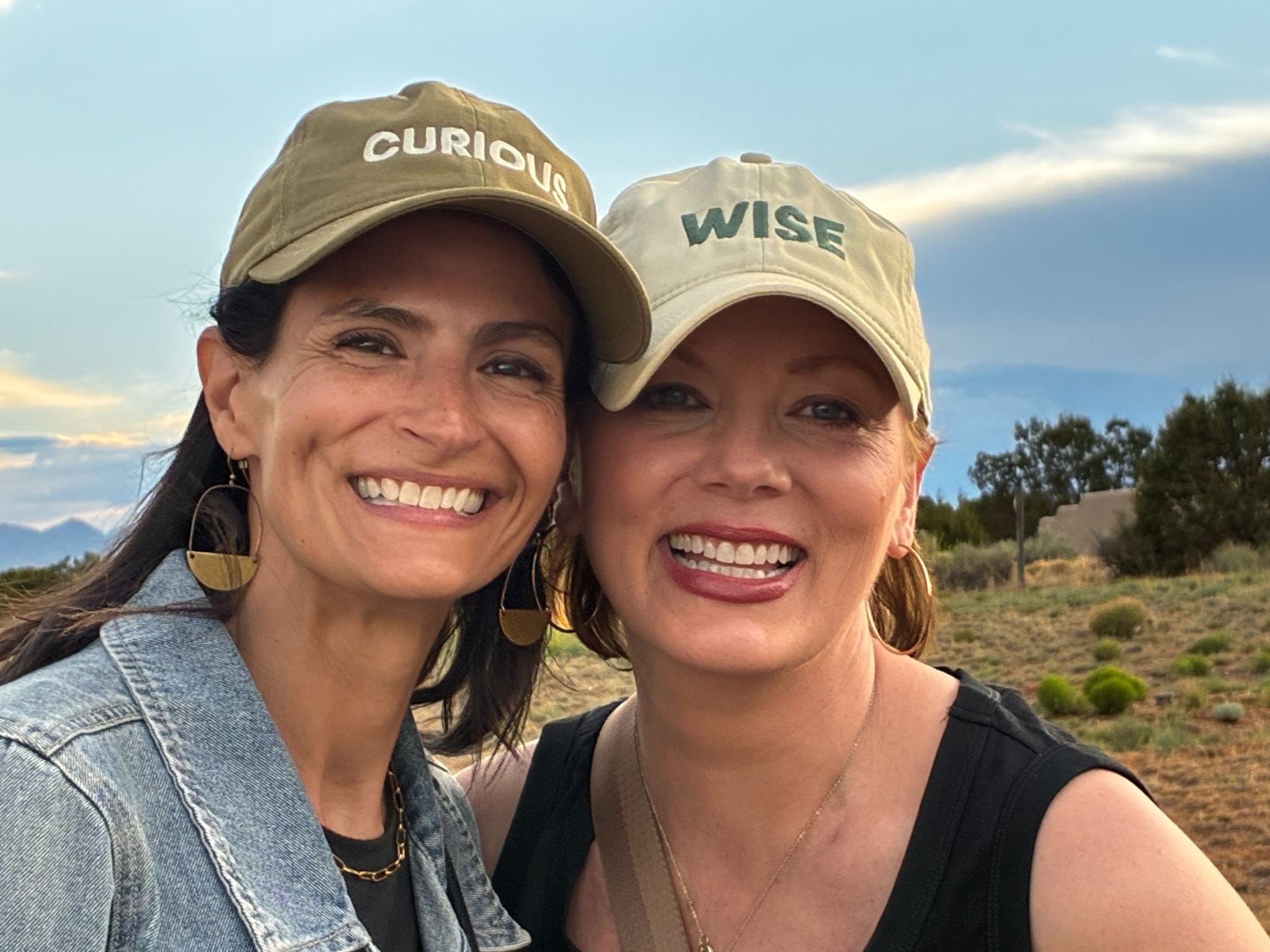
P.S. A week ago, we celebrated our 6th MEA Alumni Homecoming reunion which was both deep and fun, a flourishing combination. Speaking of a flourishing combination, take a look at these two alums - Mae and Chris - exhibiting their MEA caps that define what it means to be a “modern elder,” both curious and wise.
This sure did get me to thinking !
Hi Chip!
I loved your morning message! Thank you for the fresh perspective and analogy of borders!
I look forward to reading your insights every day. I hope you are feeling good today.
Blessings to you! 🙌🫶🙏❤️